Research Updates
August 2026
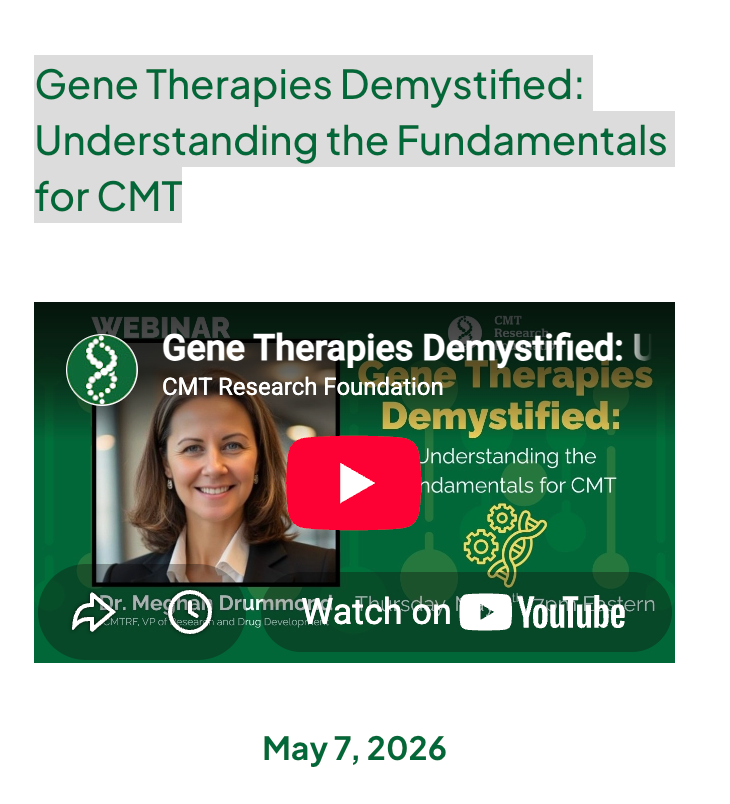
The CMT Research Foundation hosted three helpful webinars about genetic medicines.
The series is called
Genetic Therapies Demystified
The webinars are linked below, but they can also be found here on CMTRF's website.


July 2026
Taking Aim at CMT1J with a Genetic Medicine
click here for press release link
The CMT Research Foundation, in partnership with the 1J Foundation, has funded a new study at the University of Miami led by Dr. Stephan Züchner to evaluate a newly-identified genetic variant linked to Charcot-Marie-Tooth disease type 1J and to test whether a targeted genetic medicine can address it.
CMT1 is the type of CMT that damages the protective coating around nerve fibers, disrupting the electrical signals nerves use to control movement and sensation. Researchers identified a recurring variant of ITPR3 gene in 31 individuals across eight different families, all of whom presented with the slowed nerve conduction velocities characteristic of CMT1. The same variant, T1424M, appears independently across multiple families, making it a specific and compelling target for development of a genetic medicine.
Previous work in Dr. Züchner’s group focused on three pre-clinical models of this gene to understand the function of ITPR3 and what can go wrong when it is altered. These studies ruled out one initially promising approach called “exon skipping” whereby the region of the gene containing the mutation is removed in the process of making the ITPR3 protein.
In mice designed to model this exon skipping strategy, the function of the ITPR3 protein was compromised, proving to researchers that this exon is critical.
Moving forward, the team will use antisense oligonucleotides, or ASOs, short synthetic molecules already in clinical use for other neurological diseases, which can be designed to selectively dial down the faulty T1424M version of the gene. The team will optimize these ASOs in preclinical cell models and then move into early in vivo studies, building the foundation needed to attract a commercial development partner.
“ITPR3 represents a significant cause of CMT1 and the recurring T1424M allele is a specific target for ASO technology that is already in clinical use.”
Dr. Stephan Zühhner, University of Miami
Because ASO technology is already an established clinical tool, a well-supported preclinical case for this target has a realistic path toward partnership and, ultimately, patients.
November 2025
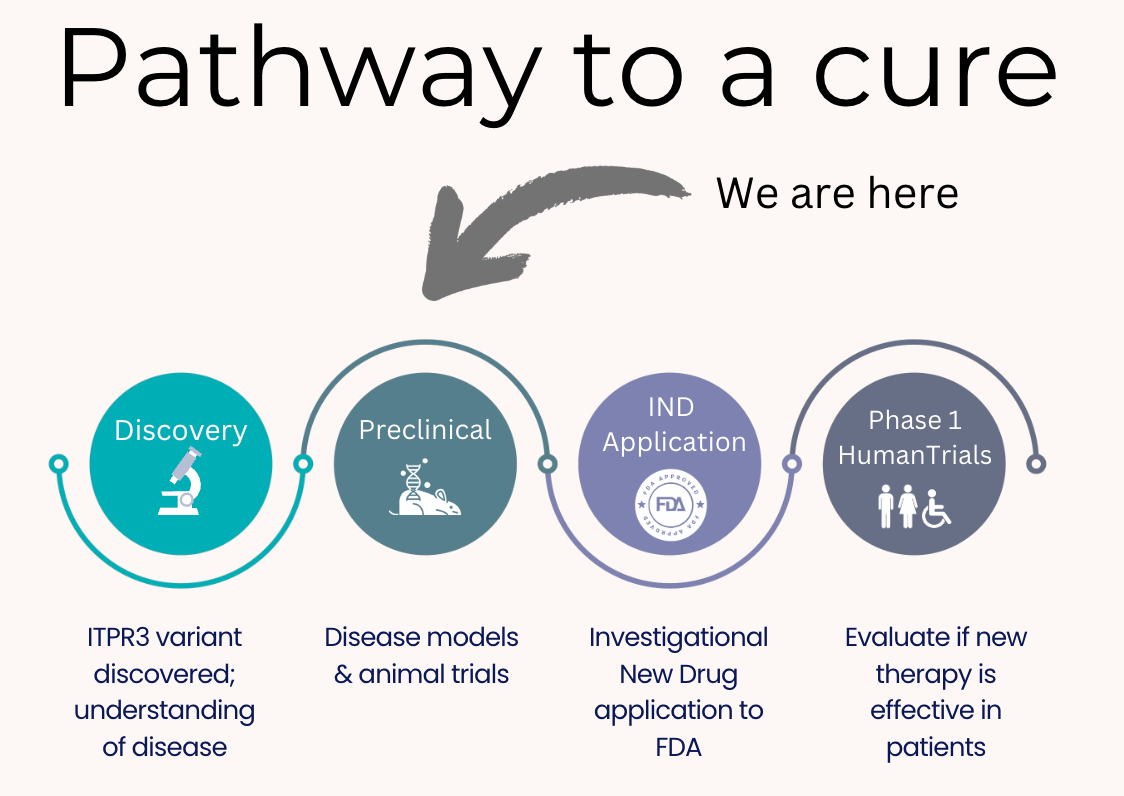
In Dr. Stephan Zuchner's lab at the University of Miami, he and his team are studying three different types of genetically modified mice. These mice are growing and aging, and they are tested regularly to measure their nerve activity and study their cells. So far, the researchers have noticed that when the mice have two copies of the mutated gene, they show multiple health issues. When they have only one copy of the mutation, they show milder nerve problems.
The research team has also found that the ITPR3 mutation causes issues with how calcium moves in cells, which is linked to the disease in CMT1J. This suggests the mutation is causing a "gain of function," meaning the gene is doing something it shouldn’t. On the bright side, the team has discovered that if one copy of the gene was removed, no disease was present. This is promising news for a treatment.
Zuchner and his team are making plans to test a gene therapy for CMT1J called antisense-oligonucleotide (ASO) therapy. ASO therapies already successfully treat other nerve diseases; ten drugs have been FDA approved and are currently on the market. Zuchner hopes to finish the mouse studies by summer 2026 and start testing the therapy his team has designed. One great benefit of these mice is that they are genetically similar to humans, so if the therapy works, it could eventually be tested in people.
February 2024
We are excited to announce the
CMT1J research project
CMT Research Foundation Partners to Advance Study of CMT1J by Dr. Stephan Zuchner
click here for press release link
ATLANTA (February 20, 2024) The CMT Research Foundation, a non-profit focused solely on delivering treatments and cures for Charcot-Marie-Tooth disease (CMT)*, has partnered with the 1J Foundation, a 501(c)(3) organization dedicated to finding a cure for patients with 1J, a newly identified subtype of CMT. The two Foundations will co-fund the development of an ITPR3 gene mutation mouse model of CMT1J under the direction of Stephan Zuchner, MD, PhD at the University of Miami, FL.
The ITPR3 gene is responsible for making a protein heavily abundant in the nervous system, especially in Schwann cells. It works as a calcium channel, controlling the flow of calcium ions in the cell. The researchers hypothesize that a specific mutation in the ITPR3 gene in CMT1J patients may interfere with the normal function of the protein, affecting calcium flow and causing issues in Schwann cells. Dr. Zuchner and his team will develop a new mouse model that contains the human ITPR3 mutation(s) which will then be used to study affected biological pathways.
This model will be available to other investigators to study CMT1J.
Other team members on this project include Dr. Mario Saporta, MD, PhD, Associate Professor at the University of Miami, Co-Investigator; Katherina Walz, Ph.D., Associate Professor at the University of Miami, Co-Investigator; Adriana Rebelo, PhD, Scientist at the University of Miami; and Clemer Abad, D.V.D, Manager, Research Support. Dr. Rob Burgess from the Jackson Laboratory has been instrumental in creating the founder animals and will collaborate with the U of Miami group on this project.
“Dr. Zuchner has a well-established track record in neurology, peripheral nerve neurology, and molecular genetics,“ says Cleary Simpson, CEO of CMTRF. “We are pleased to help further his quest to find a cure in partnership with the 1J Foundation. This is a big step towards finding a therapy for CMT1J patients and in alignment with CMTRF’s mission to resolve ALL forms of CMT.”
1J Foundation is a patient-led non-profit to fund treatment for CMT1J, one of the newest types identified. Variability in severity is one of the hallmarks of CMT1J. Symptoms can appear at any age, from infancy to late adulthood, and severity ranges from asymptomatic to fatal. Those who have symptom onset during childhood have more severe disease, so there is an urgent need to find treatment.
CMT Research Foundation (CMTRF) is a patient-led, non-profit focused on delivering treatments and cures for CMT. The foundation identifies significant obstacles or deficiencies impeding progress towards a cure and seeks out collaborators to address these issues. To date, CMTRF has funded 21 projects, of which 6 are completed. Of those 6 completed projects, 5 have clinical candidates. CMTRF’s mission to invest in promising science with high potential of leading to treatments and cures was proven effective and ground-breaking when DTx Pharma with a CMTRF- backed program as its lead candidate was acquired by Novartis for $1 billion. Founded by two patients who are driven to expedite drug delivery to people who live with CMT, the 501(c)(3) federal tax-exempt organization is supported by personal and corporate financial gifts.
*Charcot-Marie-Tooth encompasses a group of inherited, chronic peripheral neuropathies that result in nerve degradation. CMT patients suffer from progressive muscle atrophy of legs and arms, causing walking, running and balance problems as well as abnormal functioning of hands and feet. CMT affects one in 2,500 people (about the same prevalence as cystic fibrosis), including 150,000 Americans and nearly 3 million people worldwide. At the moment, there is no treatment or cure for CMT.
CMTRF
4062 Peachtree Road Suite A209
Atlanta, GA 30319
404-806-7180
cmtrf.org
University of Miami, FL
Miller School of Medicine
1600 NW 10th Ave #1140
Miami, FL 33136
305-243-2281
med.miami.edu